
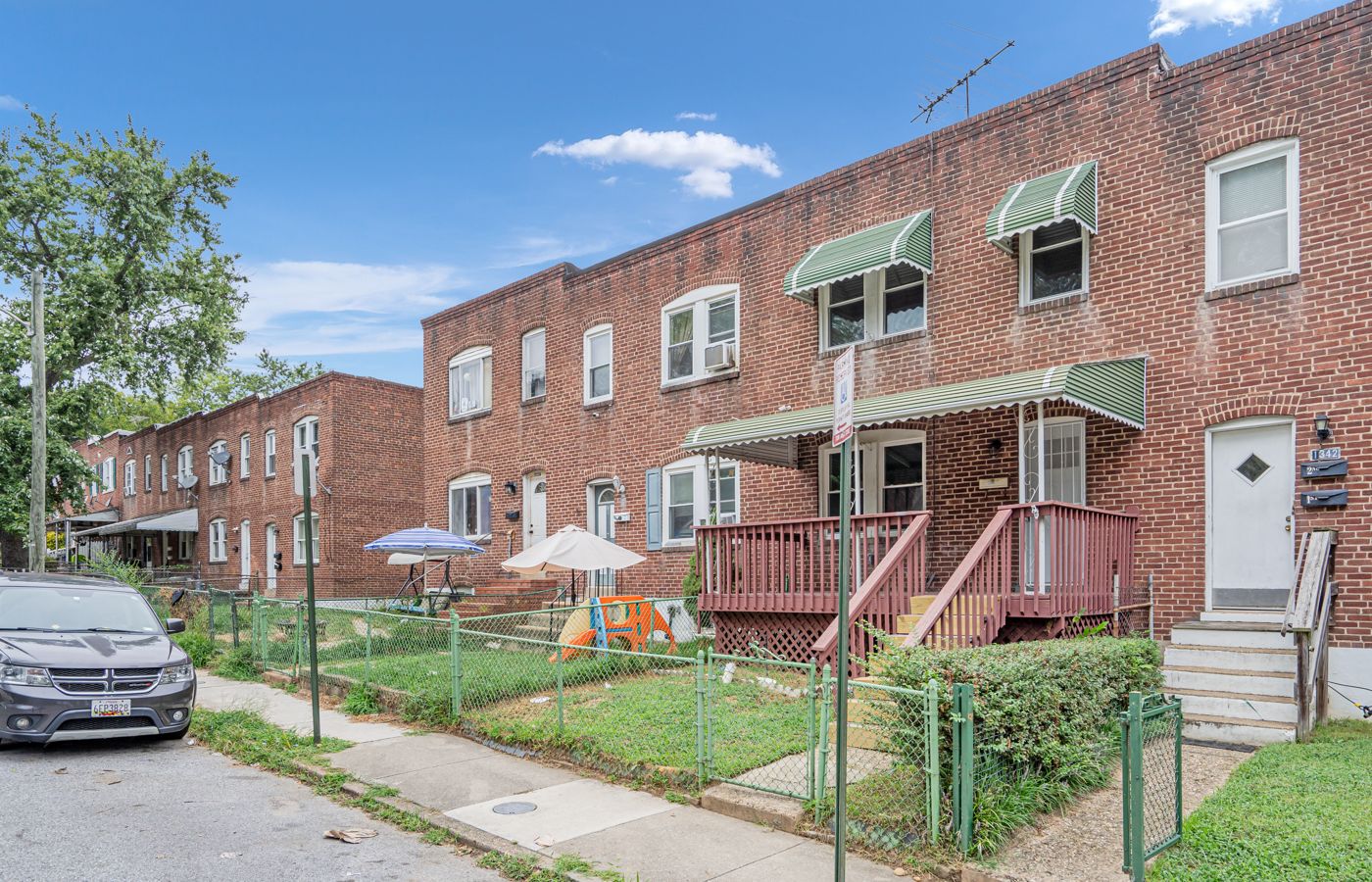
A Baltimore rental makes money when the rent covers more than the mortgage. It also has to cover a city property tax rate more than twice the Baltimore County rate, licensing and lead paperwork, vacancy, repairs and a reserve for the roof. Run all of those costs before you make an offer, not after. Below is the full cost stack and a worked example with every assumption written down, so you can swap in your own numbers.
I have been buying, renovating and renting Maryland houses for about 20 years, and our investor services are built around the same math. Nothing here is a promise of returns. It is a method.
The cost stack
These are the line items every Baltimore City rental carries. Rates are as of October 2026.
| Cost | What it is | Source |
|---|---|---|
| Property tax | $2.248 per $100 of assessed value (city) plus $0.112 (state) = $2.36 per $100, for July 2026 to June 2027 | SDAT tax rate table |
| Transfer and recordation taxes at purchase | City transfer tax 1.5%, recordation $5 per $500, state transfer tax 0.5% | Baltimore BBMR, Tax-Property 13-203 |
| Property registration | $30 per dwelling unit per year for a non-owner-occupied 1-2 unit property | City Code Art. 13, 4-8 |
| Rental license inspection | A private inspection by a Maryland-licensed home inspector registered with the city; you pay the inspector | DHCD property registration |
| Lead registration | Every pre-1978 rental unit is registered with MDE (see the fee note below) | MDE rental owners |
| Lead inspection | A lead inspection certificate at each change of tenant, unless the home is certified lead-free | MDE rental owners |
| Insurance | A landlord (dwelling fire) policy, not a homeowner policy | Get quotes; it varies by house |
| Management | SW Property Management charges 10% of rent collected, plus one month’s rent to place a tenant | Our fee schedule |
| Vacancy, repairs, reserves | Your assumptions; pick numbers you can defend | You |
Two of those deserve a note.
The tax rate is the number out-of-town investors miss most. Baltimore City’s $2.248 compares with $1.10 in Baltimore County on the same SDAT table. The homestead credit cap only protects owner-occupied homes, so a rental’s tax bill follows its full assessment. Our Maryland property tax guide explains assessments and the cap.
The lead registration fee is in flux. As of October 2026, MDE’s own rental owner page still lists a $30 annual fee per unit. The state’s OneStop registration page lists $75 per unit, renewed every two years. Budget for the higher figure and confirm when you register.
A worked example
This is an example, not a deal we did and not a forecast. Every assumption is labeled so you can change it.
The rent comes from our own listings. As of October 2026, the three Baltimore rowhomes on our rentals page are listed at $1,575, $1,795 and $1,800 a month, all three-bedroom townhouses with the tenant paying gas, electric and water. Those are asking rents, not signed leases, so I used $1,750 as the example rent.
Assumptions:
- Purchase price: $180,000, for a house that is already renovated and rent-ready (no rehab in this example)
- Assessed value equals the purchase price (yours will differ; look it up before you offer)
- Rent: $1,750 a month
- Vacancy: one month a year
- A new tenant every two years
- Insurance: $1,500 a year (placeholder; get a real quote)
- Repairs: 8% of gross rent; capital reserve (roof, HVAC, water heater): 5% of gross rent
- Rental license inspection: $200 every two years; lead inspection at turnover: $300 every two years (both placeholders; get quotes)
Annual numbers:
| Line | Amount |
|---|---|
| Gross rent ($1,750 x 12) | $21,000 |
| Vacancy (one month) | -$1,750 |
| Rent collected | $19,250 |
| Property tax ($180,000 x $2.36 / $100) | -$4,248 |
| Management (10% of rent collected) | -$1,925 |
| Leasing fee (one month’s rent every two years) | -$875 |
| Insurance (assumed) | -$1,500 |
| Repairs (8% of gross rent) | -$1,680 |
| Capital reserve (5% of gross rent) | -$1,050 |
| City property registration | -$30 |
| Rental license inspection (assumed, per year) | -$100 |
| MDE lead registration ($75 every two years) | -$38 |
| Lead inspection at turnover (assumed, per year) | -$150 |
| Total operating costs | -$11,596 |
| Net operating income (NOI) | $7,654 |
That NOI is 4.3% of the $180,000 price, before closing costs and before any loan.
Now add financing. Fannie Mae’s Eligibility Matrix (August 5, 2026) allows up to 85% loan-to-value on a one-unit investment purchase, so the smallest down payment is 15%. Investor loans cost more than the owner-occupant average. For reference, Freddie Mac’s PMMS put the 30-year fixed average at 7.32% for the week of October 22, 2026. I assumed 8.0% for an investor loan.
| Financing case | Loan | Annual payment (P&I) | NOI minus payment |
|---|---|---|---|
| 15% down ($27,000) | $153,000 | $13,472 | -$5,818 |
| 25% down ($45,000) | $135,000 | $11,887 | -$4,233 |
| All cash | $0 | $0 | $7,654 |
Under these assumptions the house does not pay for its own mortgage. At 8% over 30 years, $7,654 a year supports a loan of about $87,000. Anything bigger and you are feeding the property every month.
I’m not showing that to talk you out of Baltimore. It tells you where the money in these deals actually comes from: buying below the renovated value and adding the value yourself, or putting more cash in. Paying full retail for a finished house and borrowing 85% doesn’t get you there. If your spreadsheet says a turnkey rowhome cash-flows at 15% down, check the tax line and the vacancy line first.
Rehab realities
Most Baltimore deals that make sense on paper involve work. A rowhome built before 1978 can need a roof, a rear wall repointed, new plumbing and a panel upgrade, as well as the kitchen and bath an investor plans for. The finishes are the part you can see. The systems are where budgets go wrong.
We aren’t publishing cost ranges here, because every house is different and an average would mislead you. What I’d tell any investor:
- Get a written bid from a licensed contractor during your inspection period, while you can still walk away.
- Ask the contractor to price the systems first (roof, masonry, plumbing, electrical, HVAC), then finishes.
- Pull the permit history. A rehab done without permits can leave a property without the use and occupancy permit the city expects (more in our post on buying a vacant house in Baltimore).
- Check the contractor’s MHIC license. Our guide to the Maryland home improvement license shows what it covers.
My company, Monarch Bay Renovations, prices renovations for our investor clients during the inspection period.
Affiliated business disclosure: Stephen Wilson owns Monarch Bay Renovations (MHIC #149066). You are never required to use it, and you can hire any licensed contractor.
Licensing and lead compliance
In Baltimore City you register first, then license. Every non-owner-occupied property, including vacant buildings and lots, has to be registered with DHCD every year. Registration is due by January 1 and within 10 days of any transfer. For a rental license you also need:
- a passing inspection from a Maryland-licensed home inspector registered with DHCD, uploaded within 90 days of the inspection
- current lead certification information for each unit
- no open code violations
Under the Strengthening Renters’ Safety Act, effective January 1, 2026, every rental license runs for two years and licenses no longer transfer on a sale. A buyer needs a new license within 60 days of the transfer. Owners also have to post the license number in leases and advertisements, and a missing posting carries a $250 citation.
On lead: rentals built before 1978 must be registered with MDE, and each change of tenant needs a valid lead inspection certificate unless the home is certified lead-free. The details are in our planned posts on the Baltimore City rental license and Maryland lead paint rules for landlords, and the landlord-tenant guide covers deposits and leases.
Financing: conventional, DSCR and hard money
Conventional investment loans. Fannie Mae’s August 5, 2026 matrix caps a one-unit investment purchase at 85% loan-to-value and a 2-4 unit investment purchase at 75%. These loans qualify you on your personal income and debts.
DSCR loans. These are non-agency investor loans that underwrite the property’s rent against its payment instead of your personal income. Terms vary by lender, and they usually cost more than a conventional loan. Read the prepayment terms closely.
Hard money. Short-term loans for buying and renovating, usually refinanced or paid off at sale. They are built for speed, not for holding. Your exit has to be clear before you borrow.
Owner-occupant loans. If you will live in one unit, a 2-4 unit home with an FHA or conventional owner-occupant loan needs a far smaller down payment. That is a different strategy, covered in house hacking in Baltimore. For a fixer, see renovation loans in Maryland.
This is general information, not tax, legal or lending advice. Talk to a lender, a CPA and an attorney about your own situation before you buy.
Exit options
Decide how you get out before you buy.
- Hold and rent. The example above, with whatever assumptions fit your house.
- Refinance after renovation. If the renovated value supports a new loan, you can pull some cash back out. This depends on the appraisal, not on what you spent.
- Sell. A rental sale is taxed differently from a home sale. Read selling a rental property in Maryland for depreciation recapture and 1031 exchanges.
- Sell with the tenant in place. Possible, with rules on notice and showings. See selling a house with tenants in Maryland.
Foreclosures and HUD homes are another way in. Our HUD home guide explains how those sales work.
What we do for investors
We work investment deals as one team. Stacey and I find and negotiate the house, Monarch Bay Renovations prices and does the work, and SW Property Management leases and manages it with the same crew handling turnovers. When it’s time to sell, we list it.
If you already own a Baltimore rental, a free rent analysis shows what it should lease for. If you’re shopping, browse Baltimore City and County homes for sale or read about the Baltimore region, then send us an address and we’ll run the numbers with you.
Bottom line
A Baltimore rental’s numbers start with $2.36 per $100 in property tax, a city registration and license, lead compliance and a real vacancy assumption. On a $180,000 rent-ready house at $1,750 a month, our example nets about $7,650 a year before the mortgage. That doesn’t carry an 8% loan on 85% of the price. Run your own version of that table on every house, and get the rehab bid during your inspection period, before you sign anything final.
Sources
- Maryland SDAT, Tax Rates 2026-2027 and Homestead Credit Caps (checked October 26, 2026)
- Baltimore City BBMR, City tax rates (checked October 26, 2026)
- Maryland Code, Tax-Property 13-203, state transfer tax (checked October 26, 2026)
- Baltimore City Code, Article 13, 4-8, registration fees (checked October 26, 2026)
- Baltimore City DHCD, Property registration and rental licensing (checked October 26, 2026)
- Baltimore City DHCD, Strengthening Renters’ Safety Act (checked October 26, 2026)
- Maryland Department of the Environment, Rental owners (checked October 26, 2026)
- Maryland OneStop, Lead paint rental unit registration (checked October 26, 2026)
- Fannie Mae, Eligibility Matrix, August 5, 2026 (checked October 26, 2026)
- Freddie Mac, Primary Mortgage Market Survey, week of October 22, 2026 (checked October 26, 2026)
- The Wilson Home Team, Rentals page, listed rents (checked October 26, 2026)